OUR project
Construction of a Community Developmentalist State of Cameroon
Cameroon, often called "Africa in miniature" due to its cultural, geographical, and linguistic diversity, is at a critical crossroads in its history. This book, entitled Towards the Emergence of the Community Developmentalist State of Cameroon: Development Policy Project based on the Network of Local Communities, proposes a holistic and inclusive development model that integrates local dynamics and draws inspiration from the successes of East Asian development models.
The main objective of this work is to build a solid and, above all, "participatory" democracy in Cameroon, through democratic decentralization that promotes power-sharing without diluting it. Participatory democracy aims to actively involve citizens in decision-making processes, thus ensuring that their voices and concerns are heard and taken into account at all levels of governance. This requires the establishment of structures and mechanisms allowing constant interaction between local authorities and communities, such as community councils, public discussion forums, and online consultation platforms.
We support a fundamentally democratic approach, where every individual not only has the right to vote but also an active role in shaping local and national policies. This form of governance encourages transparency and accountability, and strengthens trust between government and citizens. However, it is crucial to recognize and analyze the criticisms of "Free-Market Democracy" as formulated by Amy Chua in 2003.
Amy Chua highlighted that "Free-Market Democracy," which combines free-market principles with democratic structures, has often led to ethnic instabilities and violence around the world. In many cases, this form of democracy has exacerbated social tensions by strengthening the economic and political power of the ethnic or social majority, to the detriment of minorities. This imbalance can foster the emergence of demagogues exploiting popular resentments against a minority elite perceived as privileged. The consequences are often dramatic, including massacres, ethnic cleansing, and a regression towards authoritarian regimes.
It is therefore crucial to design a democracy that, while promoting economic development, integrates robust mechanisms for the protection of minorities and the prevention of conflicts. This involves promoting a culture of tolerance and mutual respect, and establishing institutions capable of equitably managing claims and social tensions.
Assessment of Current Challenges and Crises
Political Crisis
Cameroon is marked by a deep political crisis rooted in a complex colonial history and excessive post-independence power centralization. The persistence of an authoritarian regime, embodied by Paul Biya since 1982, and unfulfilled promises of democratization have exacerbated ethnic and regional tensions. Anglophone regions, in particular, feel political and economic marginalization, leading to armed conflicts and secessionist aspirations. This situation is aggravated by the rise of Boko Haram in the north, adding an additional security dimension to political challenges.
Economic Crisis
Despite its natural wealth, Cameroon struggles to transform its economic potential into sustainable and inclusive development. The economy remains largely dependent on the export of natural resources, making the country vulnerable to fluctuations in commodity prices. Inadequate infrastructure, endemic corruption, and inefficient resource management hinder economic development. Disparities between urban and rural areas are marked, and a large part of the population lives below the poverty line. Privatization and liberalization policies have often been poorly implemented, exacerbating social inequalities.
Financial Crisis
The financial crisis is intrinsically linked to the use of the CFA Franc, a currency inherited from the colonial era and pegged to the euro. This situation limits the monetary flexibility necessary to respond to economic shocks and raises questions about Cameroon's economic sovereignty. Debates on the reform or abandonment of the CFA Franc are increasingly lively, reflecting a growing awareness of the need to rethink the monetary framework to better meet the country's development aspirations.
Security Crisis
The security crisis is multifaceted, encompassing both internal conflicts and external threats. The Anglophone regions of the North-West and South-West are the scene of increasing violence between government forces and separatist movements. At the same time, the threat of Boko Haram in the north of the country causes significant human losses and destruction. The government's military response, although necessary, has sometimes led to abuses against civilians, complicating stabilization efforts.
Socio-Cultural Crisis
Cameroon's ethnic and linguistic diversity, while a source of cultural richness, poses considerable challenges in terms of governance and national cohesion. Ethnic tensions are exacerbated by policies perceived as favoring certain groups at the expense of others, creating resentments and inter-community conflicts. These rivalries often manifest in struggles for political power and access to resources, fueling discontent and radicalization.
Proposal for an Inclusive and Sustainable Development Model
Faced with these multidimensional challenges, the book proposes a development model based on the emergence of a community developmentalist state. This model rests on three fundamental pillars: economic nationalism, the community regime, and the pursuit of strategic industrial policies. Inspired by successful development models in East Asia, this model is adapted to the socio-cultural realities of Cameroon.
Economic Nationalism
Economic nationalism is envisioned as the engine of development. It involves promoting an economic policy that prioritizes national interests, encourages local production, and reduces dependence on imports. This includes diversifying the economy, supporting local entrepreneurship, and promoting renewable energies.
Community Regime
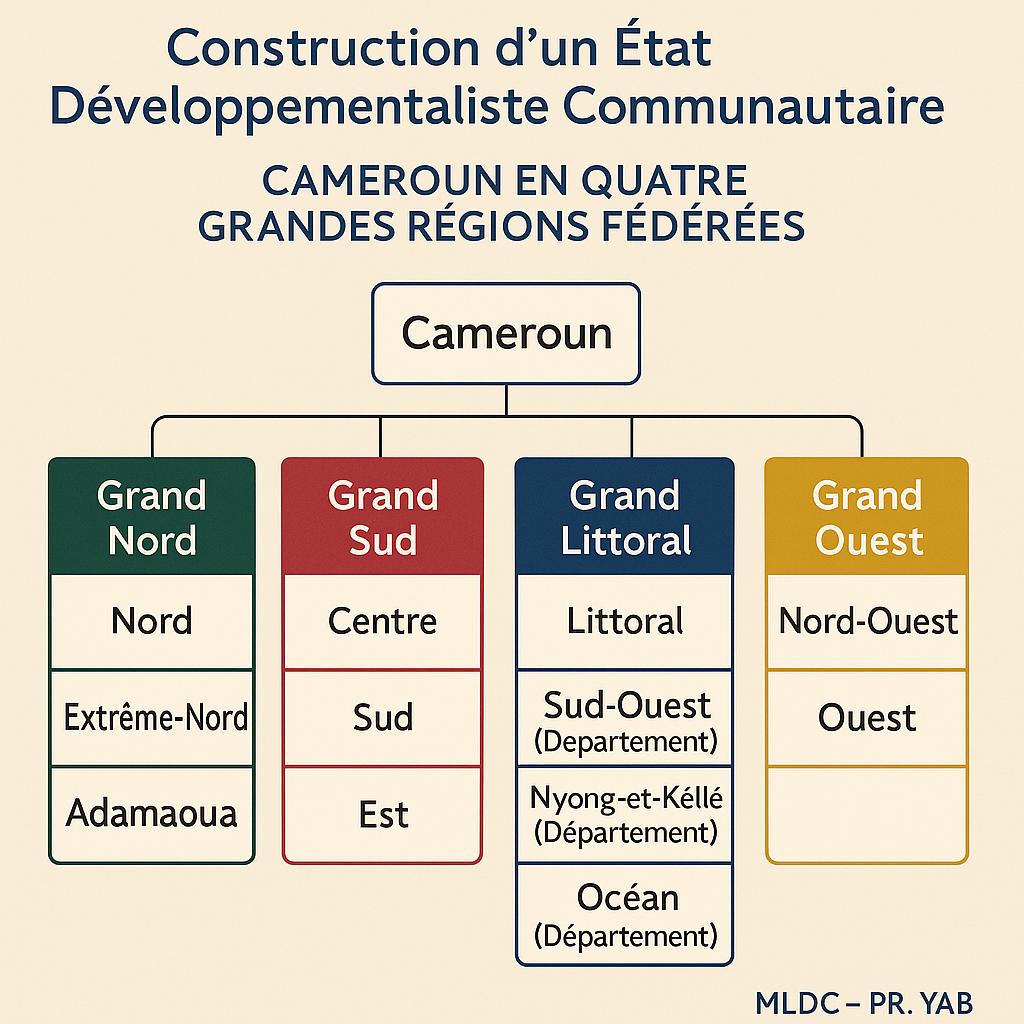
The community regime emphasizes the decentralization of power and the valorization of local dynamics. By structuring Cameroon into four large federal regions (the Grand South, the Grand North, the Grand Littoral, and the Grand West), it is possible to promote more participatory and equitable governance. Each region, endowed with regional parliaments and elected governors, could autonomously manage its affairs, thus respecting ethnic and cultural diversity while strengthening national unity.
Strategic Industrial Policies
Strategic industrial policies aim to modernize agriculture, stimulate industrial development, and invest in infrastructure. State intervention is perceived as crucial to overcome structural obstacles and catalyze investments in key sectors. Inspired by the successes of East Asian countries, this economic model prioritizes long-term strategic planning and the mobilization of resources to achieve sustainable growth objectives.
Social and Cultural Dimensions of Development
Communal Network
The proposed model also relies on the networking of Cameroon's 360 communes, aiming to strengthen local capacities and promote participatory governance. By bringing decision-making processes closer to citizens and improving the delivery of public services, this communal network ensures that development projects meet the needs of local populations and benefit from their active support.
Secularism and National Cohesion
Secularism, as a principle of separation of religion and state, plays a crucial role in managing diversity. By ensuring a practical and respectful application of religious diversities, secularism contributes to strengthening national cohesion and promoting harmonious development.
International Perspectives
Cameroon must also strengthen its position on the world stage through diplomatic strategies and international cooperation. By improving its diplomatic capacities, promoting a positive international image, and actively engaging in regional and global partnerships, the country can attract investments, access new technologies, and strengthen its institutional capacities.
Towards an Emerging and Prosperous Cameroon
The transition to a community developmentalist state represents a historic opportunity for Cameroon to reinvent its governance and promote harmonious and inclusive development. This model proposes decentralized governance, strategic state intervention, active participation of local communities, and revitalized proactive diplomacy. It is based on a paradigm shift and human capital development, allowing for a change in mentalities and offering quality education to all to foster social mobility.
A Cameroon of States
This Cameroon is envisioned as a confederation where all Cameroonians will live in peace, fostering emulation and development synergy. The objective is to achieve an emerging Cameroon in one generation, well-governed, based on the principles of a rule of law and an environment of democracy, tolerance, and respect.
A Cameroon of Sustainable Development
The economy will be circular, with wealth produced by activities shared equitably. This agro-green and industrial Cameroon will preserve and locally transform its natural resources, supported by the federal state and federated states.
A Social Cameroon
The fight against exclusion and discrimination will be at the heart of this model, promoting the reintegration of people with disabilities, respecting gender equality, and encouraging training and dialogue. Solidarity will contribute to reducing social inequalities and promoting local products, with operational health and social systems.
In conclusion, this book aims to be a roadmap for Cameroon, highlighting an innovative and pragmatic vision to address development challenges and promote a prosperous and harmonious future for all its citizens. By integrating lessons learned from successful development models and adapting these principles to Cameroonian realities, Cameroon can aspire to a positive transformation that values its diversity while strengthening its national unity.
The model of the community developmentalist state of Cameroon is based on a holistic and inclusive approach, combining the decentralization of power, the valorization of local dynamics, and strategic state intervention to stimulate economic and social development. This model has the potential to transform Cameroon into an example of inclusive and sustainable development in Africa, thus promoting transparent governance, equitable justice, and real social inclusion.
The ambitious vision described in this book is based on a paradigm shift and the development of human capital, allowing for a change in mentalities and offering quality education to all to foster social mobility. One of the key points of this vision on education will be the establishment of a City of Knowledge, positioning Cameroon as a regional hub of reference in higher education and research.
"Let's do it"
The Legal Foundations of Cameroon in Four Large Federated Regions